


Struggling to get your complex parts machined correctly the first time? The endless cycle of revisions and missed deadlines eats into your budget and delays your project, making it difficult to find a reliable CNC machining partner.
This challenge often stems from a mismatch between part complexity and the CNC machine’s capabilities. You need a solution that guarantees precision and efficiency, but navigating the world of 3, 4, and 5-axis CNC machining can be overwhelming.
This guide clarifies the differences, helping you select the right process. By understanding each technology’s strengths, you can partner with a CNC machining shop like [Company Name] that meets your specific needs for quality, delivery, and service, ensuring your project’s success.
Therefore, understanding the distinctions between 3-axis, 4-axis, and 5-axis CNC machining is crucial. This knowledge empowers you to make informed decisions, consequently optimizing your manufacturing process for both cost and quality. In addition, it ensures that you select the most suitable technology for your specific components.
The Evolution and Importance of Multi-Axis CNC Machining
CNC machining technology is central to modern manufacturing, enabling the precise creation of complex components. At its core, the number of “axes” a CNC machine has defines its movement capabilities and the complexity of the parts it can produce. This article will explore the differences and applications of 3-axis, 4-axis, and 5-axis CNC machining to help you choose the right fit.
Understanding the “axis” of a CNC machine is about its degrees of freedom. These axes—linear (X, Y, Z) and rotational (A, B, C)—determine how the cutting tool and workpiece can move relative to each other. More axes mean greater capability to machine intricate geometries in a single setup.
Our goal is to compare 3-axis, 4-axis, and 5-axis CNC machining. We’ll examine their differences and highlight their unique value in various manufacturing scenarios.

3-Axis CNC Machining: The Foundational Standard
3-axis CNC machining operates on three linear axes: X, Y, and Z. The cutting tool moves along these paths to shape the material. This method is straightforward and widely used for simpler parts.
This process is cost-effective and relatively simple to program. However, it is limited in its ability to handle complex curves and undercuts, often requiring multiple setups for a single part, which can affect accuracy and efficiency.
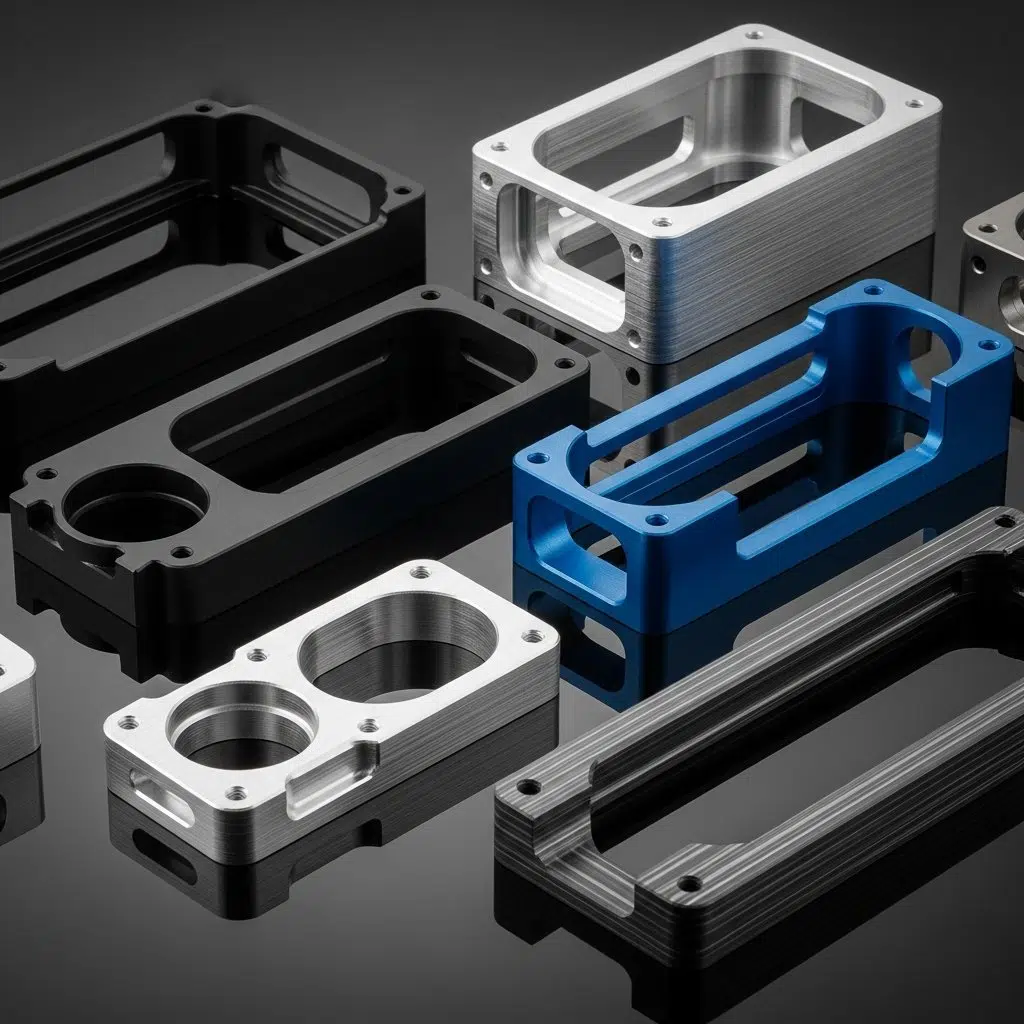
You will typically find 3-axis CNC machining used for tasks like milling flat surfaces, drilling holes, and creating basic structural components and molds.
4-Axis CNC Machining: Enhancing Efficiency
4-axis CNC machining builds upon the 3-axis foundation by adding a rotational axis, usually the A-axis. This allows the workpiece to be rotated during the machining process.
The primary advantage is the ability to machine multiple sides of a part in one clamping. This capability is ideal for cylindrical parts and significantly boosts production efficiency. It reduces setup time and improves accuracy by minimizing manual repositioning.
Despite its benefits, 4-axis CNC machining still has limitations. It may not be suitable for parts with highly complex, free-flowing curves and can present challenges with tool interference on certain geometries.
Common applications for 4-axis CNC machining include manufacturing cams, gears, propeller blades, and other cylindrical or multi-faceted components.

5-Axis CNC Machining: Mastering Complexity
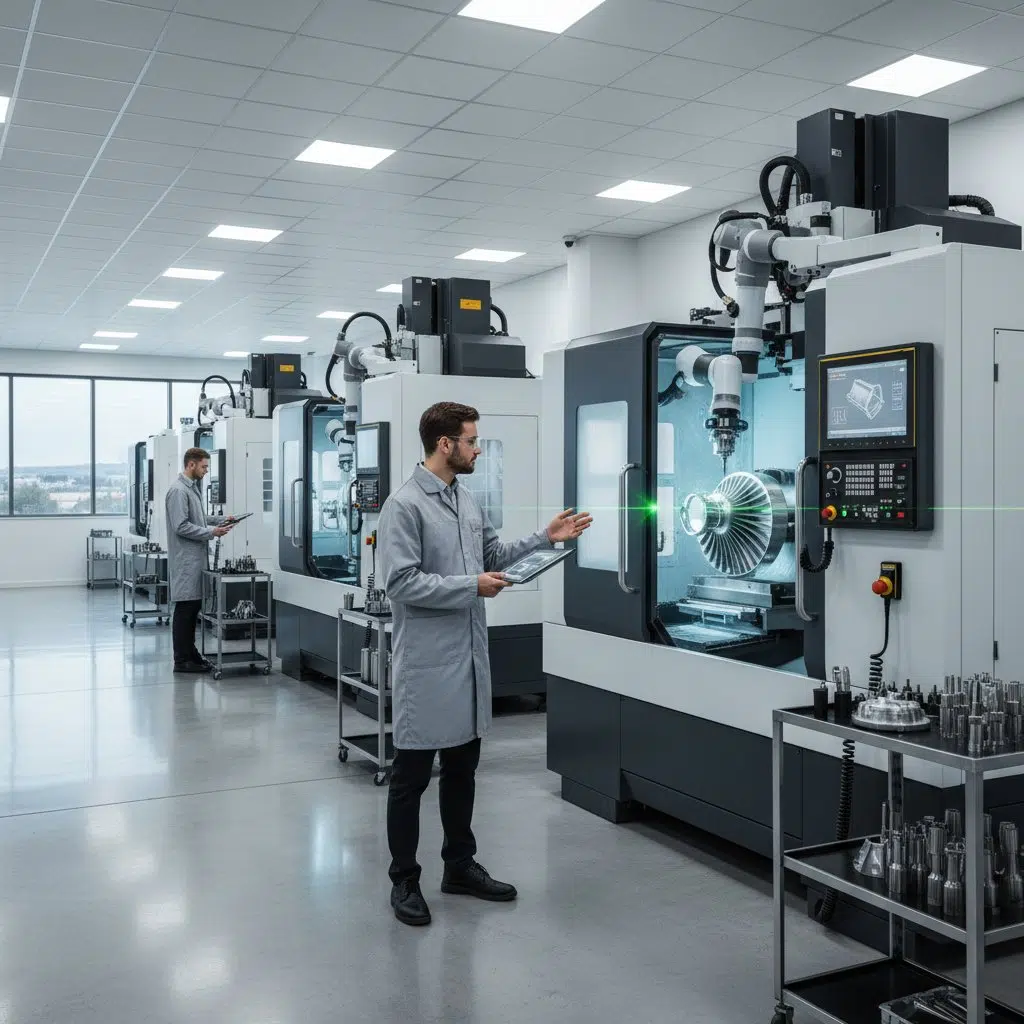
5-axis CNC machining introduces two rotational axes to the standard three linear axes. This setup allows the cutting tool to approach the workpiece from virtually any direction in a single setup.
This advanced capability enables the creation of highly complex geometries and free-form surfaces with exceptional precision and surface finish. By completing all machining in one clamping, it drastically reduces errors and lead times while eliminating the need for custom fixtures.
The main considerations for 5-axis CNC machining are the higher initial equipment cost and the increased complexity of programming and operation. It requires skilled technicians and sophisticated software to unlock its full potential.
This technology is indispensable in industries like aerospace for parts such as turbine blades and impellers, in the medical field for orthopedic implants, and for creating intricate molds and dies.
Comparison and Selection Guide for CNC Machining
Choosing the right CNC machining process is critical for achieving your desired outcome. Factors like part complexity, required precision, and production budget all play a role in this decision.
Key Performance Parameter Comparison
Cost-Benefit Analysis
When analyzing costs, consider the entire production cycle. While 3-axis machines have a lower initial investment, the need for multiple setups can increase labor costs and lead times for more complex parts. 5-axis CNC machining, although more expensive upfront, can deliver a lower cost-per-part on complex jobs due to its efficiency.

How to Choose the Right Number of Axes
Selecting the appropriate CNC machining axis count depends heavily on your product’s specific requirements.
First, consider the geometric complexity of your part. If it features deep cavities or intricate, multi-angled surfaces, 5-axis CNC machining is likely the better choice. For simpler, prismatic shapes, 3-axis machining is often sufficient.
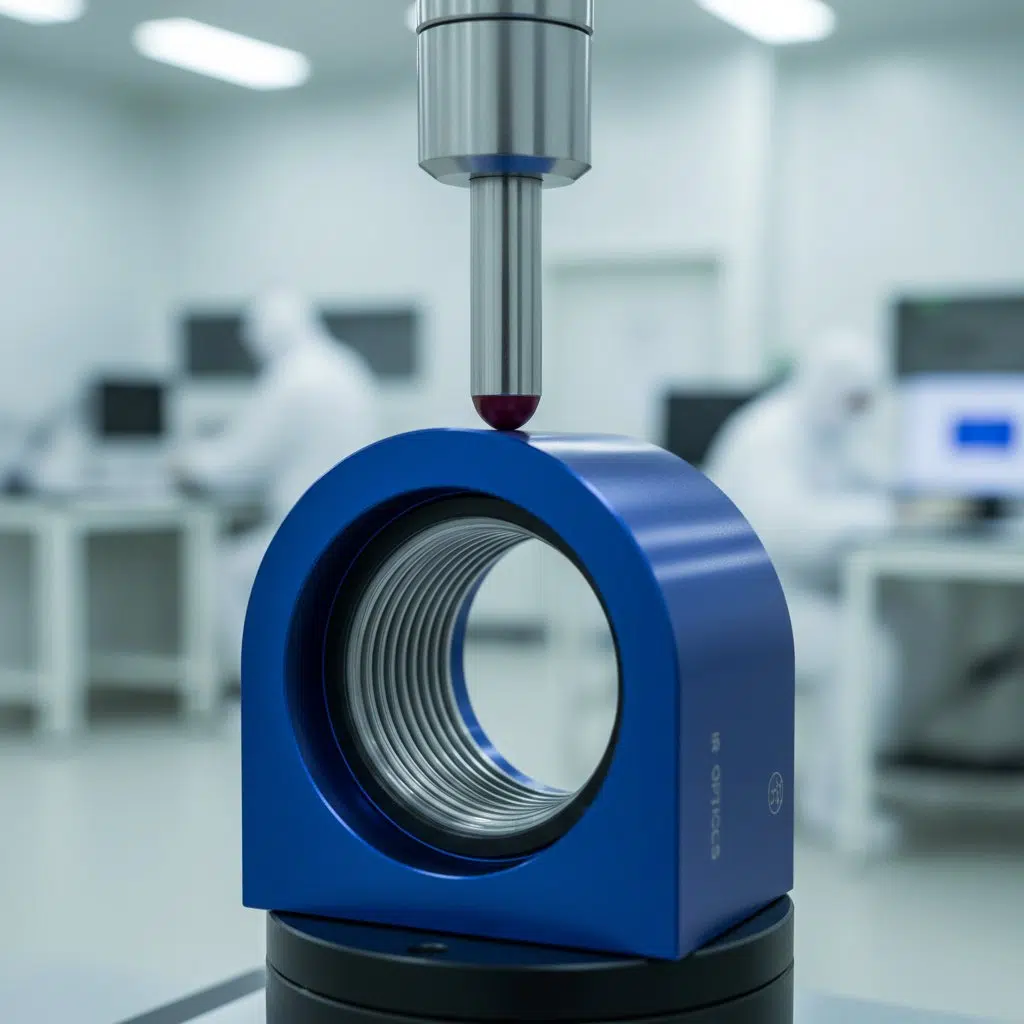
Next, evaluate the required precision and surface finish. Because 5-axis machines allow for shorter, more rigid cutting tools, they can achieve a superior surface finish and tighter tolerances. This is crucial for high-performance applications.
Finally, analyze your production volume and budget. For high-volume production of complex parts, the efficiency of 5-axis CNC machining often justifies the investment. For prototypes or small batches of simpler parts, 3-axis or 4-axis machining provides a more economical solution.
Case Studies
Aerospace Turbine Blade: The complex curvature and stringent tolerance requirements of a turbine blade can only be efficiently met with 5-axis CNC machining, which allows for continuous toolpaths across the entire surface.
Automotive Wheel Hub: A 4-axis CNC machine excels at producing wheel hubs, as it can machine the lug nut holes and other features on multiple faces in a single setup.
General Machinery Bracket: For a simple mounting bracket, 3-axis CNC machining offers the most cost-effective solution, quickly producing the part without the need for complex programming or setups.

FAQ
What is the difference between simultaneous 5-axis and 3+2 axis machining?
Simultaneous 5-axis machining involves the continuous movement of all five axes at the same time to create complex contours. In contrast, 3+2 axis machining (or positional 5-axis) locks the two rotational axes in a tilted position while the three linear axes perform the cutting, simplifying the process for less complex, multi-angled parts.
Is 5-axis CNC machining always the superior choice over 3-axis or 4-axis?
Not necessarily. The ideal choice depends on the specific part requirements. For simple parts, 3-axis CNC machining is more cost-effective and faster to program. 5-axis machining is only superior when the part’s complexity demands it.
How does increasing the number of axes affect programming and operator skill?
As the number of axes increases, so does the complexity of programming and the skill required to operate the machine. 5-axis CNC machining demands advanced CAM software and highly trained machinists to manage intricate toolpaths and avoid collisions.
Conclusion and Future Outlook
In conclusion, selecting the appropriate number of CNC axes is a critical decision that directly impacts manufacturing efficiency, quality, and cost. From the foundational utility of 3-axis machines to the complex capabilities of 5-axis systems, each level offers distinct advantages.
Looking ahead, the trend in multi-axis CNC machining is moving towards greater intelligence, automation, and hybrid processes. These advancements promise to further refine manufacturing, making it faster, more precise, and more versatile than ever before.
 English
 German
 Turkish
 Spanish
 French